
Rapides Parish Court Records After Arrest
The Rapides Parish arrest-to-court pathway starts with booking, usually through Detention Center I. The jail record captures arrest charges, custody, and bond status. After that, the Rapides Parish District Attorney reviews reports and evidence and decides what formal charge, if any, should be filed. Once a case opens, the court record belongs with the Rapides Parish Clerk of Court and the court system, not the jail roster.
That distinction is critical. Booking charges can be changed, reduced, expanded, or dismissed after prosecutor review. The court record controls the case number, formal charges, hearings, motions, plea, trial, disposition, sentence, and expungement path. For custody and booking details, use Rapides Parish jail inmate records. For booking photos, use Rapides Parish jail mugshots. Court records after a jail arrest should be checked with the Clerk and, for prosecutorial role, the District Attorney.
Arrest to Rapides Parish Court Record
The local flow is straightforward, even when the case facts are not. An arresting agency books the person into the jail system. DC-I is the all-parish intake point identified by RPSO. The jail entry may include arrest charges and bond status. The prosecutor then reviews the matter and decides whether to file a bill of information, seek an indictment, proceed by complaint, amend a charge, or decline to proceed.
- Arresting agency books the person, normally through Rapides Parish Detention Center I.
- The jail record captures arrest or booking charges, custody status, and bond information.
- The District Attorney reviews the arrest report and supporting evidence.
- The formal court case opens with the Clerk of Court or the correct court system.
- The court record controls charge status, hearings, amendments, disposition, sentence, and expungement eligibility.
This is why a Rapides Parish court record after arrest can look different from the first roster entry. The jail is recording custody intake. The court is recording the legal case.
Search Rapides Parish Court Records
Start with the Rapides Parish Clerk of Court and the Clerk's online services page. The research did not capture exact court-portal field labels, so use the live system's available defendant-name or case-number search if those options are present. Older cases, sealed cases, expunged matters, juvenile matters, and records not placed online require direct contact with the Clerk.
| Search Need | Best Channel | Record Boundary |
|---|---|---|
| Filed charge or case number | Rapides Parish Clerk of Court | Court record, not jail custody record. |
| Prosecutor filing decision | Rapides Parish District Attorney | DA role, not final case docket. |
| Current custody or bond | DC-I booking desk or RPSO jail records | Jail status, not conviction status. |
| Release notification | Louisiana VINELink | Custody notice, not court docket. |
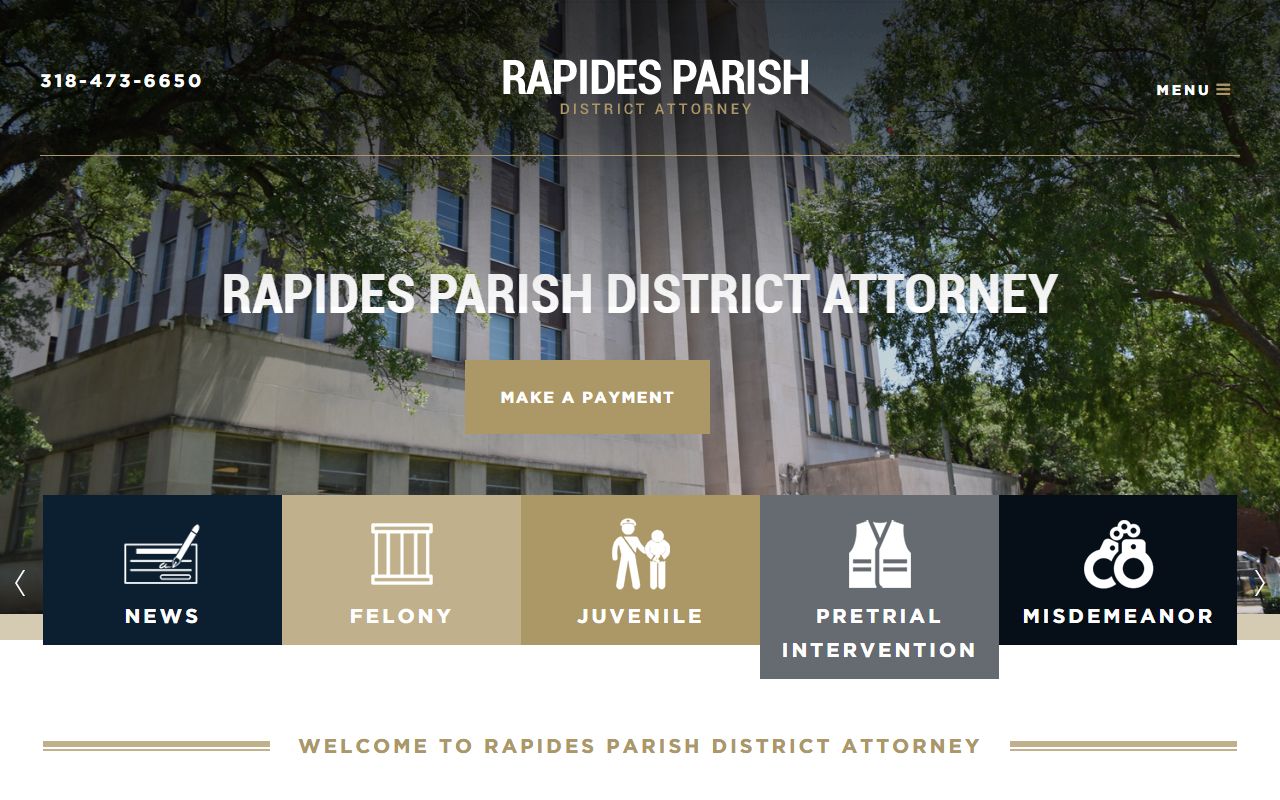
The District Attorney page is a matched screenshot source for this topic. The capture comes from the Rapides Parish District Attorney official site, which is the office responsible for state criminal prosecution in the parish.
Charging Documents After Arrest
Louisiana criminal cases can begin through different filings depending on the offense and procedure. In Rapides Parish, the DA may file a bill of information in many cases, a grand jury may return an indictment in serious cases, and a complaint may appear at an early stage. The label matters because it shows how the accusation reached court, but none of these labels is the same as a conviction.
| Document | Who Uses It | What It Means |
|---|---|---|
| Complaint | Officer, prosecutor, or court process | Early accusation or case-starting paper, depending on court procedure. |
| Bill of information | District Attorney | Prosecutor-filed formal charge used in many Louisiana criminal cases. |
| Indictment | Grand jury | Grand-jury charging instrument, often used for serious felony matters. |
Rapides Parish Charge Status
Charge status can change as court records after arrest move through prosecutor review and court action. A pending charge may later be amended, reduced, dismissed, or resolved by plea or verdict. A jail roster charge can remain a useful intake clue, but it should not be used as the final statement of what the court filed or how the case ended.
| Status | Plain Meaning | Where to Verify |
|---|---|---|
| Pending | The case or charge is still open. | Clerk or court case record. |
| Amended or reduced | The filed charge changed after review or court action. | Updated docket and filings. |
| Dismissed | The charge ended without conviction. | Court disposition record. |
| Nolle prosequi | The prosecutor declined to proceed with the charge. | DA filing or court minute entry. |
| Convicted or guilty plea | The case ended in a finding or plea of guilt. | Final disposition and sentence record. |
Bond After Rapides Parish Arrest
Bond is part of the first custody and court events after arrest. RPSO Bonds & Fines handles local bond and fine channels during Monday-Friday business hours, while the Main Office Desk Sergeant may handle bonds outside those hours. DC-I directs current detainee bond questions to the on-duty supervisor at (318) 473-6750 because DC-I is the intake facility.
| Bond Type | How It Works |
|---|---|
| Cash, cashier's check, or money order | Accepted payment instrument posted through the sheriff or court channel. |
| Surety | A licensed bail agent posts a bond when court rules allow it. |
| Property | Real or property security may be used if authorized by court rules. |
| Personal recognizance | Release based on a court order and promise to appear. |
| No bond or hold | Release is blocked unless a judge or holding agency changes status. |
Important: A parish bond may not release the person if another court, DOC, probation, federal agency, or ICE has a separate hold.
Warrants and Court Records
A warrant can lead to a Rapides Parish jail arrest once served. After booking, the person may appear in the RPSO inmate search or recent-arrest feed, but there was no official active-warrant search table found in the research. The RPSO manifest does identify a Most Wanted feature, which should be treated as a public list rather than a full warrant database.
Bench warrants can originate in municipal, district, or other courts. Check the court case record, contact the issuing court, speak with counsel, or confirm status with law enforcement if surrender or bond planning is needed. Do not rely on the jail roster alone to resolve a warrant question.
Charges vs Convictions
Rapides Parish court records after a jail arrest may show a charge long before guilt is decided. A charge is an accusation filed in court. A conviction is a final outcome through plea, verdict, or other court judgment. Public records can contain both, so the status line and disposition matter.
| Point | Charge | Conviction |
|---|---|---|
| Stage | Accusation after arrest or prosecutor review. | Final finding or guilty plea. |
| Meaning | Not proof of guilt. | Court-determined outcome. |
| Where found | Charging document, docket, minute entry. | Disposition, sentence, judgment, minute entry. |
Sealed and Expunged Records
Louisiana public-record access is broad, but it is not absolute. Rapides Parish arrest and court records can be limited by juvenile status, sealing, expungement, active investigation, medical or safety concerns, and other statutory exemptions. Louisiana Public Records Law begins with Title 44, including the right to inspect public records under La. R.S. 44:31 and custodian duties under La. R.S. 44:32. Expungement provisions are found through the Louisiana Code of Criminal Procedure.
| Record Treatment | Public Effect | Practical Step |
|---|---|---|
| Sealed | Public access is restricted by court order or law. | Ask the Clerk what public portions, if any, remain available. |
| Expunged | Eligible records may be removed from ordinary public access. | Use Louisiana expungement procedure and court filings. |
| Juvenile or protected record | Often withheld or limited. | Do not expect standard public online access. |
Rapides Parish Record Limits
Louisiana Public Records Law lets people seek public records from the proper custodian, but a custodian may withhold or redact records when a statute allows it. Law-enforcement material, juvenile records, sealed or expunged records, victim-safety information, medical records, and facility-security details can be restricted. For court records after arrest, the Clerk is the usual record custodian for filed cases. For jail records not online, RPSO Jail Records is the local jail-record channel.
Casual lookup is also different from a regulated background check. Do not use court records after a Rapides Parish arrest for employment, credit, tenant screening, insurance, or another Fair Credit Reporting Act purpose unless the search is handled through a lawful consumer reporting process.